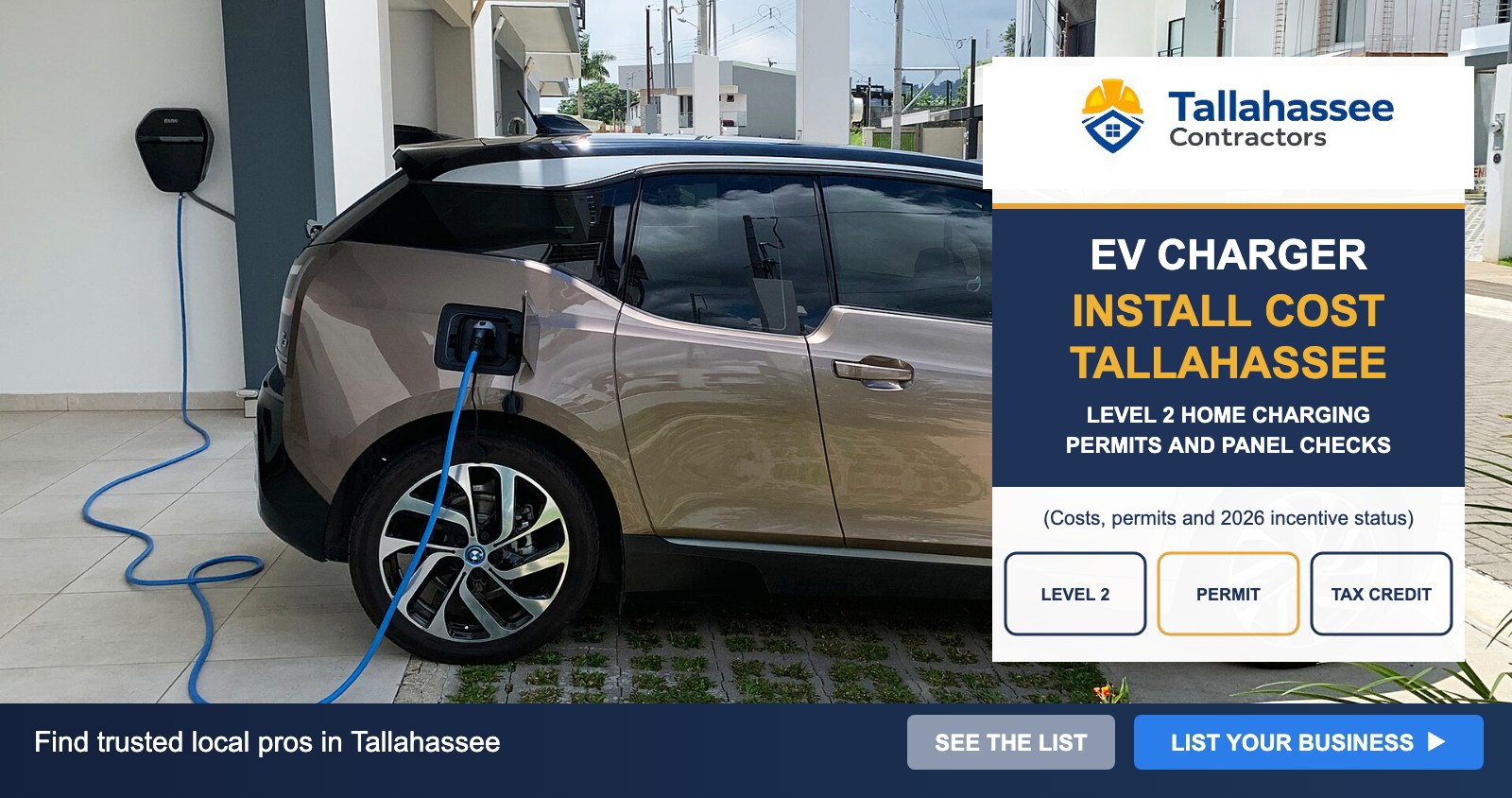
More Tallahassee drivers are going electric, and a Level 2 charger in the garage or driveway is usually the most convenient way to charge at home. Here’s what installation costs, how the City’s electrical permit works, whether your panel can handle the load, and where federal and local incentives stand as of October 2026.
How much does Level 2 EV charger installation cost?
We didn’t find Tallahassee-specific survey data, so these national figures from Angi’s 2026 cost guide are a starting point (Angi):
| Cost item | Typical range |
|---|---|
| Level 2 (240V) charger, installed | $700 – $2,000 |
| Charger hardware alone | From $300 to over $1,000 |
| Electrician installation labor | $400 – $1,200 |
| New wiring (long runs, older homes) | +$500 – $1,500 |
| Electrical panel upgrade, if needed | $800 – $2,000 |
| Permit (varies by city) | About $100 – $200 |
Angi puts the average charging-station install at about $963, with most landing between $551 and $1,380 (Angi). The local permit is usually much less than Angi’s range (see below). For local labor rates, see our guide to electrician costs in Tallahassee.
What affects the price?
- Distance from the panel. Angi says installs get cheaper the closer the charger is to the main panel. A detached garage or a driveway spot far from the panel needs a longer wire run (Angi).
- Circuit size. The U.S. Department of Energy’s Alternative Fuels Data Center says Level 2 units “require a dedicated 40-Amp circuit to comply with the National Electric Code requirements in Article 625.” It adds that Level 2 charging adds roughly 25 miles of range per hour (AFDC). Higher-powered chargers need a larger circuit and heavier wire.
- Hardwired vs. plug-in. Some units plug into a 240V outlet, the same kind used for a dryer or range. Others are wired straight into the circuit. Outdoor installs may need weatherproofing (Angi).
- Smart features. Wi-Fi scheduling and load-management features add to the hardware price.
Does your electrical panel have room?
This is the biggest variable in cost. A Level 2 charger draws a heavy load for hours at a time. Your electrician should do a load calculation to check that your panel and service can handle the charger along with your AC, water heater, range and dryer. If there’s no capacity, the options include a smaller circuit, a load-management device, or a panel or service upgrade, which Angi estimates at $800–$2,000 for the panel (Angi). Older Tallahassee homes may have small or outdated panels. Our guide to electrical safety in older Tallahassee homes covers the warning signs.
Do you need a permit to install an EV charger in Tallahassee?
In most cases, yes. The City of Tallahassee’s permit FAQ says an electrical permit is “required when any new electrical circuits are added, extended or service is changed” (City of Tallahassee), and a dedicated charger circuit is a new circuit. The City’s fee schedule, effective October 1, 2026, lists a $70.07 application fee for 1- and 2-family homes, small per-item charges such as $0.88 per outlet and $15.63 per service or sub-panel, and a $2.50 training surcharge on each electrical permit (City of Tallahassee fee schedule). The schedule has no flat fee for EV chargers, so ask your electrician for the exact permit cost. The licensed electrician normally pulls the permit and schedules the inspection. If you live outside city limits, Leon County handles permits. See our City vs. County permit guide.
This is general information, not legal or tax advice. Confirm permit and tax questions with the City, the County or a tax professional.
Is there still a federal tax credit for home EV chargers in 2026?
Not for new installs. The IRS says the Alternative Fuel Vehicle Refueling Property Credit (Section 30C) “will not be allowed for any property placed in service after June 30, 2026” (IRS). The Department of Energy lists the credit as expired as of that date. For residential equipment it was worth up to 30% of the cost, capped at $1,000, and only in qualifying locations (AFDC). If your charger was installed and working on or before June 30, 2026, ask a tax professional whether you can still claim it on your 2026 return.
Does City of Tallahassee Utilities offer EV charger rebates?
As of late October 2026, we didn’t find one. City Utilities’ list of customer programs includes rebates for HVAC, water heaters, ENERGY STAR appliances and high-performance homes, plus energy-efficiency loans, but no EV charger rebate (City of Tallahassee Utilities). The City does run public PowerTLH charging stations, including a fast-charging site on West Van Buren Street, and it lists 850-891-4968 for questions (City of Tallahassee). Programs change, so call before you buy.
How to hire an electrician for an EV charger
- Hire a licensed electrical contractor, not a handyman. Here’s how to verify a Florida license, and our guide to finding a licensed electrician in Tallahassee.
- Ask for a load calculation before you get a price, and ask whether the quote includes the permit and inspection.
- Check whether the charger you plan to buy is listed for safety and compatible with your vehicle’s connector.
- Compare at least two or three written quotes using our tips on comparing contractor estimates.
Find a local pro
Ready to install? Browse licensed electricians in Tallahassee in our directory.
Are you a Tallahassee contractor? List your business in our directory.
Image credits — cover photo: BMW i3 home charging L2 CRI 07 2021 9745 by Mariordo (Mario Roberto Durán Ortiz), CC BY-SA 4.0, via Wikimedia Commons.


Leave a Reply