Concrete shows up all over a Tallahassee property: driveways, patios, sidewalks, garage and shed slabs, house foundations and decorative pool decks. Done well, it lasts for decades. Done poorly, it cracks, settles or holds water against your house. Our local soils, heavy summer rain and high heat all affect how concrete should be planned, placed and cured. This guide explains the common project types, the technical basics worth understanding, permit questions for driveway aprons, and how to compare bids. At the end you will find the concrete companies currently listed in our directory.
Common Concrete Projects
Driveways
Driveways carry the heaviest loads on most residential lots, so subgrade preparation, thickness and reinforcement matter most here. Widening an existing driveway or adding a parking pad is also a common job.
Patios and Sidewalks
Patios and walkways carry foot traffic and furniture, so they can often be thinner than a driveway, but they still need proper slope so water drains away from the house.
Slabs and Foundations
Garage, shed, workshop and home addition slabs, along with house foundations, are structural work. They are typically designed to engineered plans or code requirements and inspected as part of a building permit.
Decorative and Stamped Concrete
Stamped, stained and colored concrete can imitate stone, brick or tile. Overlays and epoxy coatings can refresh existing slabs and garage floors. Decorative work requires more skill and usually more maintenance, such as periodic resealing.
Tallahassee Soils and Drainage
The Tallahassee area is known for its red clay hills, with sandier soils in parts of the region, especially to the south. Clay can hold water and shift with changing moisture, while loose sand can settle if it is not compacted. Either way, the base under the concrete is just as important as the concrete itself. Ask how the contractor will remove organic material and roots, what fill or base material they use, and how they will compact it.
Drainage is the other half of the equation. Slabs should be sloped so water moves away from foundations, and downspouts should discharge where they will not undermine the edges of a driveway or patio. On sloped lots, ask whether a drain, swale or retaining wall is needed.
Weather, Pouring and Curing
Summer in Tallahassee brings intense heat and frequent afternoon thunderstorms. Heat can make concrete set quickly and lose moisture too fast at the surface, which increases the risk of cracking and a weak top layer. Sudden rain on a fresh pour can damage the finish. Experienced crews often pour early in the morning, watch the radar, keep plastic sheeting on hand and use curing methods such as wet curing or curing compounds. Ask how long you should wait before walking on the new surface and before driving on a new driveway; your contractor should give you specific guidance based on the mix and conditions.

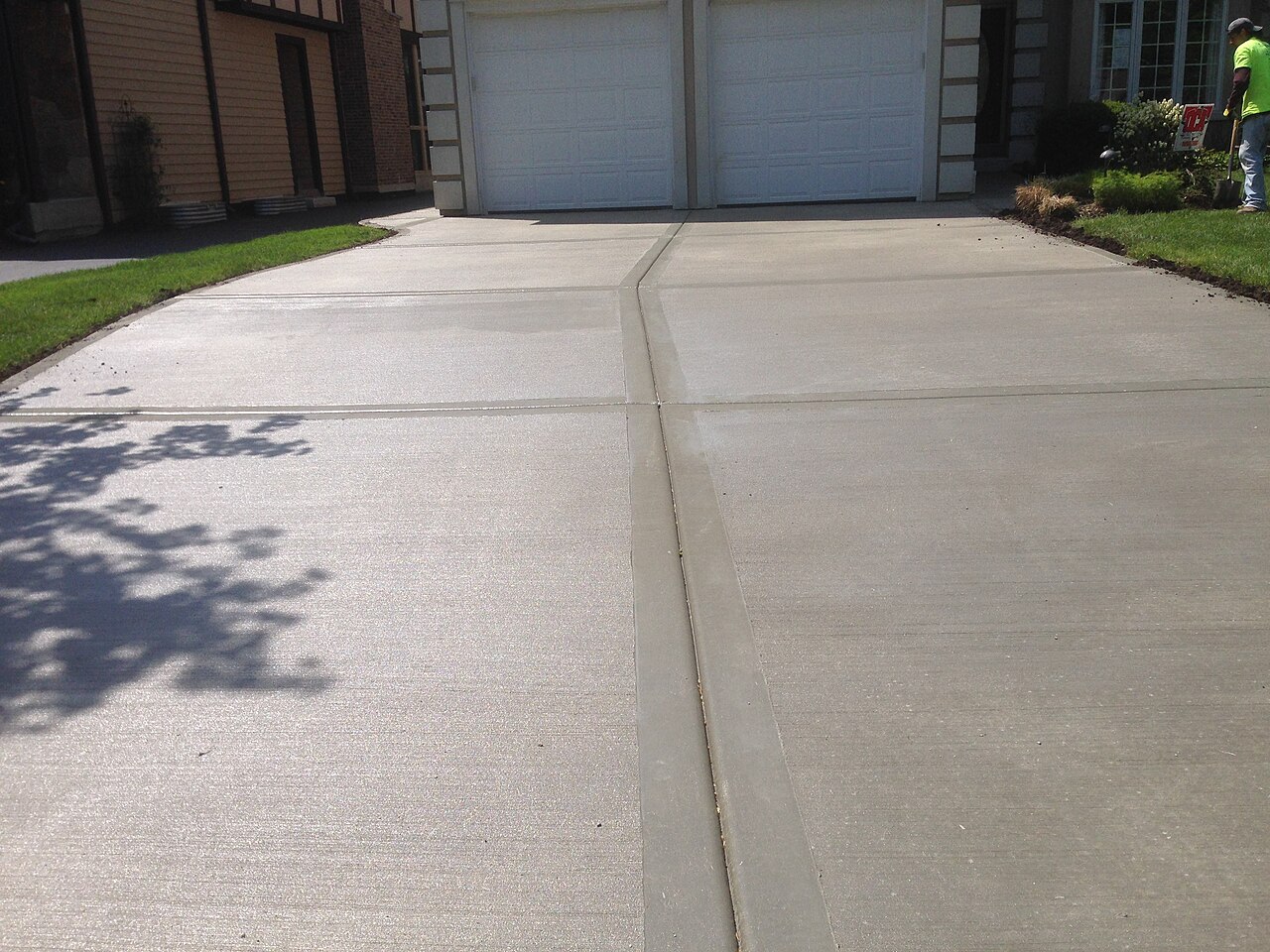
Photo: ChicagoConcrete, via Wikimedia Commons (CC BY-SA 3.0)
Concrete Basics Worth Understanding
Control Joints
Concrete shrinks as it cures and moves with temperature changes, so some cracking is expected. Control joints, cut or tooled into the slab at planned intervals, give those cracks a straight, intended place to form. Ask where joints will go and how they will be spaced; poorly placed joints often lead to random cracks.
Thickness, Rebar, Wire Mesh and Fiber
Slab thickness should match the load. Driveways are generally built thicker than walkways. Steel rebar or welded wire mesh helps hold cracked sections together and resist settling, while synthetic fibers mixed into the concrete help control small shrinkage cracks. These options are not interchangeable in every situation, so ask the contractor to state in writing the thickness, the reinforcement type and the concrete strength they plan to use.
Sealing
A penetrating or film-forming sealer can help resist staining, moisture and mildew, and it is especially important for stamped and colored concrete. Ask when the first coat should be applied after the pour and how often resealing is recommended.
Permits for Driveway Aprons and Right-of-Way Work
The apron, the section of driveway between the street and your property line, usually sits in the public right-of-way. Building or changing a driveway connection often requires a permit from the agency that controls the road: the City of Tallahassee for city streets inside city limits, Leon County for county roads, or the Florida Department of Transportation for state roads. These permits may cover apron width, materials, sidewalk crossings and drainage culverts. Foundations and structural slabs generally fall under building permits. Confirm the requirements for your address with the right office, and ask your contractor who will pull the permits. If the job involves digging, a Sunshine 811 utility locate request should be made before excavation.
How to Compare Concrete Bids
Concrete prices depend on project size, site access, demolition of existing concrete, base work, reinforcement, finish type and current material costs, so the lowest number is not always the best value. When reviewing quotes, compare them line by line:
- Scope: exact square footage, thickness and finish, and whether removal and haul-off of old concrete is included.
- Site prep: grading, base material, compaction and any drainage work.
- Reinforcement: rebar, wire mesh, fiber or a combination.
- Joints, curing and sealing: how they will be handled and whether sealing is included.
- Permits and inspections: who obtains them and whether fees are included.
- Licensing and insurance: proof of liability and workers’ compensation coverage.
- Warranty and payment schedule: what workmanship issues are covered, for how long, and when payments are due.
Ask for photos or addresses of recent similar jobs, and get every commitment in writing.
Concrete Companies in Our Directory
The companies below are listed alphabetically. This is not a ranking or an endorsement; it is a starting point for your own research. Visit each listing for details, and browse all concrete contractors in Tallahassee in our directory.
- CSC Construction Services handles foundations, slabs, driveways, curbs and retaining walls, as well as DOT work.
- DreamCrete specializes in decorative concrete, including stamped and stained finishes, overlays and epoxy.
- J & H Masonry & Concrete builds driveways, patios and sidewalks and also does brick masonry and chimney work.
- John Ross Concrete pours driveways, patios and sidewalks and handles concrete repairs.
- Marco’s Masonry & Concrete builds driveways and patios and also works with brick and stone.
- Sam The Concrete Man Tallahassee is a local franchise that installs driveways, patios and foundations, including stamped and colored concrete.
- Yount’s Concrete pours slabs, sidewalks and driveways and also offers demolition.
Frequently Asked Questions
Do I need a permit to replace my driveway in Tallahassee?
Often, yes, if the work touches the apron in the public right-of-way or changes the driveway connection. Check with the City of Tallahassee, Leon County or FDOT, depending on who maintains your road.
Why does new concrete crack?
Concrete shrinks as it cures and moves with temperature and soil moisture. Proper base preparation, control joints, reinforcement and curing reduce cracking and help keep any cracks along the joints.
Is stamped concrete a good choice in Florida heat?
It can be, as long as it is installed by an experienced crew and sealed regularly. Ask about slip resistance for pool decks and about lighter colors, which tend to stay cooler underfoot.


Leave a Reply