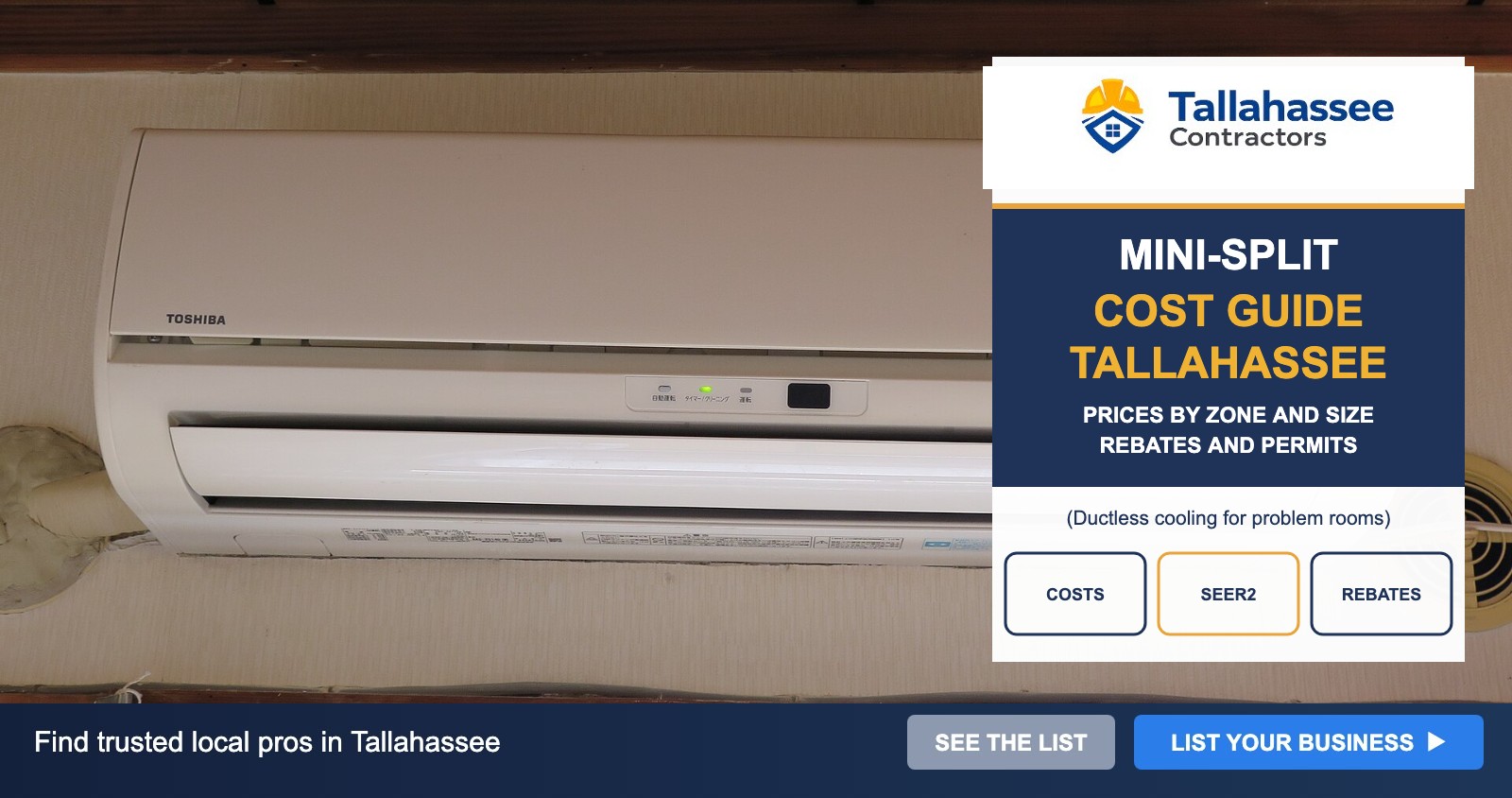
A ductless mini-split is often the simplest way to cool a room that your central AC can’t reach: a converted garage, a new addition, a sunroom, or an older Tallahassee home that was never built for ductwork. Given how long and humid our cooling season is, they’ve become a common request. This guide covers what mini-splits cost according to national price guides, when they make sense, what SEER2 ratings mean, which City of Tallahassee Utilities rebates apply, and the Florida licensing and permit rules to know.
Replacing a whole-house central system instead? See our AC replacement cost guide for Tallahassee. For planning other projects, start with our Tallahassee home improvement guide.
How much does a ductless mini-split cost?
Price depends mostly on how many indoor units (zones) you need and how much capacity each room requires. These installed ranges come from national guides, not Tallahassee-specific data:
| System | Typical installed cost |
|---|---|
| Single-zone | $2,500–$6,000 |
| 2-zone | $4,500–$8,000 |
| 3-zone | $6,500–$11,000 |
| 5-zone | $10,000–$15,000 |
| 12,000 BTU (1 ton) single unit | $3,500–$5,000 |
| 24,000 BTU (2 ton) single unit | $6,000–$8,000 |
Source: HomeGuide.
Angi puts a typical installed mini-split at about $3,000, with a range of $2,000 to $14,500 (Angi). Angi also lists these add-ons that can show up on a quote: around $250 for a dedicated electrical circuit if you need one, $250–$400 for a permit and $80–$150 to remove an old window or wall unit (Angi).
What affects mini-split price
- Number of zones: each extra indoor head adds equipment and labor.
- Capacity: a larger room, high ceilings, lots of west-facing glass or a poorly insulated garage needs more BTUs. Ask for a load calculation rather than a guess.
- Line set length: quotes usually include a standard run of about 15 feet, and longer runs cost more (HomeGuide).
- Electrical capacity: an older or full panel may need work first. See our panel upgrade cost guide.
- Indoor unit style: wall-mounted heads usually cost least. Ceiling cassettes and concealed ducted units cost more.
- Efficiency rating: higher SEER2 units cost more up front but may qualify for a larger utility rebate.
When a mini-split makes sense
- Garage conversions: extending existing ducts into a garage often overloads the main system. A dedicated mini-split keeps the new room comfortable without shortchanging the rest of the house.
- Additions and sunrooms: a separate zone avoids upsizing the central system.
- Older homes without ducts, or with ducts in a cramped attic: wall heads avoid tearing into plaster and ceilings. Our older-home renovation guide covers other issues common in those houses.
- Hot or humid problem rooms: a bonus room over the garage, or a bedroom at the end of a long duct run.
A mini-split won’t fix a room that loses its cooling through the ceiling. Check insulation first. See attic insulation and ventilation for Florida homes.
SEER2 ratings explained
SEER2 and EER2 replaced the older SEER and EER ratings on January 1, 2023, when the U.S. Department of Energy updated its testing procedures. In the southern region, which includes Florida, the minimum for split-system air conditioners under 45,000 BTU became 14.3 SEER2, and split-system heat pumps nationwide must meet 14.3 SEER2 and 7.5 HSPF2 (NAHB, 2022). Many mini-splits are heat pumps that also heat in winter, and many are rated well above the minimum. A higher number means lower operating cost for the same cooling.
City of Tallahassee Utilities rebates for mini-splits
If you get electric service from the City of Tallahassee, its HVAC rebate program explicitly includes split and mini-split systems (City of Tallahassee Utilities, page updated 10/20/2026):
| Equipment | Bronze ($100) | Gold ($350) |
|---|---|---|
| Air conditioner (split / mini-split) | SEER2 15.2 and EER2 12.0 | SEER2 17.0 and EER2 12.0 |
| Air-source heat pump (split / mini-split) | SEER2 15.2, EER2 11.0, HSPF2 7.8 | SEER2 16.0, EER2 11.0, HSPF2 8.0 |
To qualify, the system must be a complete AHRI-matched system with a valid AHRI reference number, installed under a permit with a passed final inspection. For existing homes, the application is due within 90 days of the final inspection, and the rebate is credited to your utility account (City of Tallahassee Utilities). Rebates can change without notice, so confirm before you buy. Our overview of City of Tallahassee utility rebates covers the other programs. If a different utility provides your electricity, check its programs instead.
Licensing: who can install a mini-split in Florida
Installing a mini-split for pay is air-conditioning contracting under Florida law. Look for a state-licensed air-conditioning contractor (license numbers starting with CAC) or mechanical contractor (CMC). Florida statute defines Class A air-conditioning contractors without a tonnage limit, and limits Class B contractors to 25 tons of cooling and 500,000 Btu of heating per system, more than enough for a residential mini-split (Fla. Stat. § 489.105). A DBPR guide lists installing a central air-conditioning unit for pay as work that needs a license, while plugging in a window unit does not (DBPR, via Columbia County). Check any license with our Florida license lookup guide, and see Florida contractor license types explained.
“DIY” mini-split kits are sold online, but the permit requirements above still apply. A self-install also won’t qualify for the City rebate without a permit and passed inspection.
Permits for mini-splits in Tallahassee and Leon County
Inside city limits, a mechanical permit is required when heating or air conditioning equipment is extended, relocated or changed out, and an electrical permit is required when new circuits are added. Each trade needs its own permit (City of Tallahassee). A garage conversion or addition will usually need a building permit too. Outside the city, contact Leon County at 850-606-1300 (Tallahassee-Leon County permit portal), and see City vs. County building permits. This is general information, not legal advice. Confirm requirements with the permitting office.
Questions to ask before you hire
- Will you do a load calculation for each room?
- Does the system qualify for the City rebate tier I want, and will you provide the AHRI number?
- Will you pull the mechanical and electrical permits?
- Where will the outdoor unit, line set and condensate drain go?
- What are the equipment and labor warranties, and who registers the equipment?
Compare two or three written bids using our tips on how to compare contractor estimates.
Find a local pro
Browse general contractors in our directory for garage conversions and additions, and electricians for dedicated circuits and panel work. Do you install HVAC systems in Tallahassee or Leon County? List your business for free.
Image credits — cover photo: Wall-mount AC by Douglas Paul Perkins, CC BY-SA 4.0, via Wikimedia Commons.


Leave a Reply