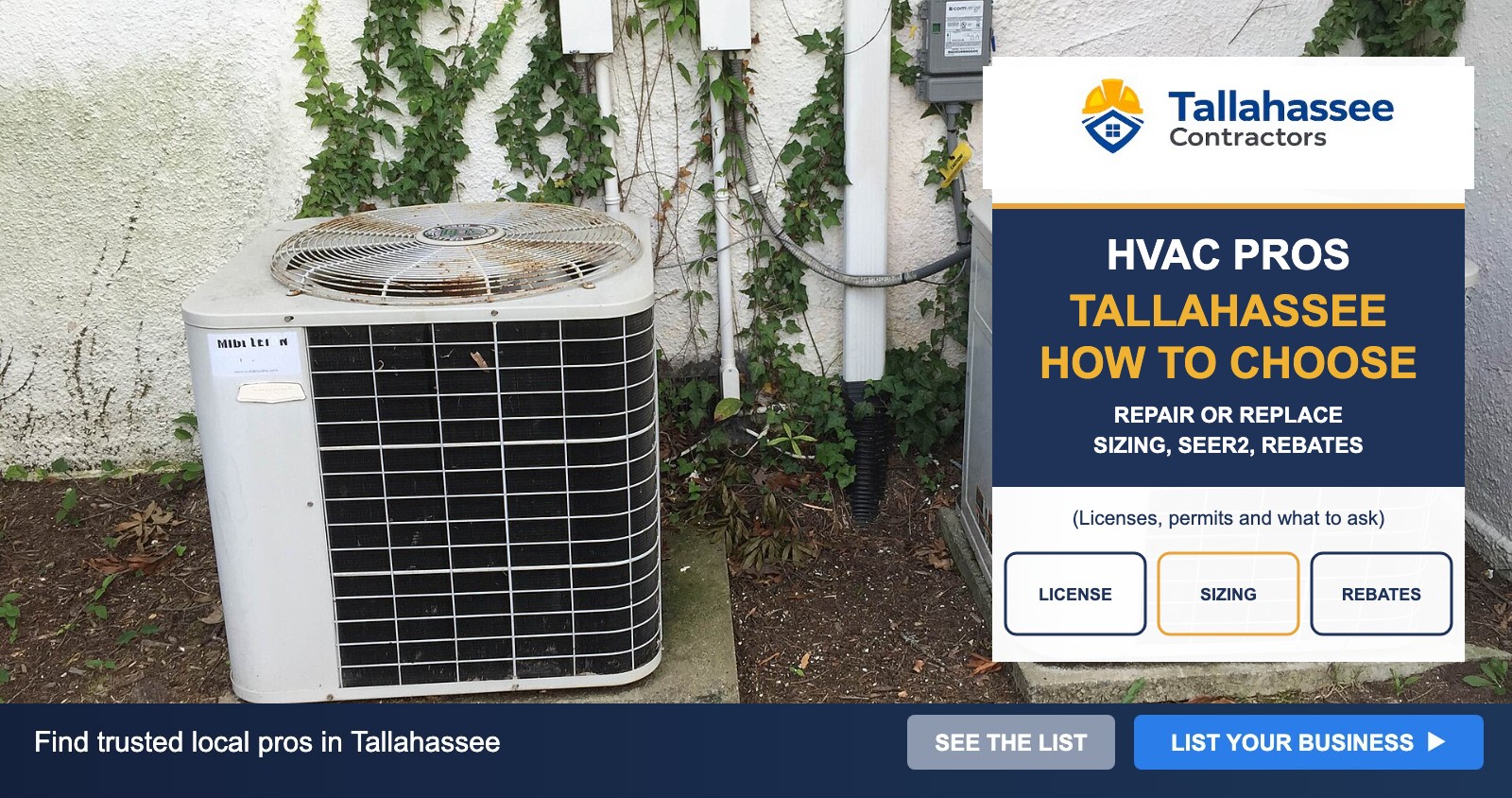
In Tallahassee, the AC runs most of the year, and it tends to quit on the hottest weekend in July, which is a bad time to pick a contractor in a hurry. This guide covers repair vs. replacement, Florida HVAC licenses, sizing for our humidity, SEER2 minimums, City rebates, permits, what a quote should include, and the HVAC contractors listed in our directory.
For prices on a full system, see our AC replacement cost guide for Tallahassee. For planning other projects, start with our Tallahassee home improvement guide.
Should you repair or replace your AC?
There’s no single rule, but a few questions narrow it down:
- What refrigerant does it use? Older systems often run on R-22. U.S. production of new R-22 has ended, and after 2020 only recycled, reclaimed or previously produced R-22 can be used to service existing equipment (U.S. EPA). The EPA doesn’t require replacing a working R-22 unit, but a big leak repair on one can be hard to justify.
- One-time failure or a pattern? A bad capacitor or clogged drain line is routine. Repeated leaks or a failed compressor on an older system is when replacement quotes make sense.
- Is the house comfortable when it works? Hot rooms or a clammy feel point to sizing or ducts, which a like-for-like swap won’t fix.
Ask for the repair price, system age and refrigerant type in writing so you can compare it with a replacement quote. If several systems are aging at once, see our aging home systems checklist
Florida HVAC licenses: CAC, CMC and the classes
Florida licenses air-conditioning and mechanical contractors through the Construction Industry Licensing Board. DBPR occupation codes start with “C” for certified (statewide) contractors and “R” for registered (local) contractors. Air conditioning is listed as CA/RA and mechanical as CM/RM (Florida DBPR). Chapter 489 of Florida Statutes defines the classes (Fla. Stat. § 489.105):
| License | Scope under § 489.105 |
|---|---|
| Class A air-conditioning | Central AC, heating, refrigeration and ventilating systems with no size limit, including ductwork needed to complete the system |
| Class B air-conditioning | Same type of work, limited to 25 tons of cooling and 500,000 Btu of heating in any one system, which covers typical homes |
| Class C air-conditioning | Servicing only, not new installs; no new Class C licenses have been issued since October 1, 1988 |
| Mechanical | Unlimited HVAC and refrigeration, plus some other mechanical systems |
For a home system, a Class A, Class B or mechanical license is what you want to see. Look up the number and the business name at MyFloridaLicense.com. Our guide on how to verify a contractor license in Florida walks through the search, and Florida contractor license types explained covers the other codes.
Sizing: why a Manual J load calculation matters
“Go one size bigger” is still a common line, and it’s usually a bad idea in North Florida. A U.S. Department of Energy fact sheet says correctly sized equipment “is especially important in humid climates,” says oversizing is “very common,” and recommends ACCA Manual J to calculate loads and Manual S to select equipment. It also notes that more starts and stops wear equipment out faster (U.S. DOE, 2002). An oversized unit cools fast and shuts off before removing much moisture, leaving the house cool but sticky.
Florida’s residential energy code has its own equipment-sizing section (R403.7) built around ACCA Manual S and calculated loads, and the 2026 code update revises those rules (Florida Building Commission). Either way, ask for a room-by-room load calculation, not a guess based on the old unit’s label.
SEER2 minimums in the Southeast
Since January 1, 2023, efficiency is rated in SEER2. In the southern region, new split-system air conditioners under 45,000 Btu (about 3.5 tons and below) must be at least 14.3 SEER2, and units from 45,000 to 65,000 Btu must be at least 13.8 SEER2. Split heat pumps must meet 14.3 SEER2 and 7.5 HSPF2 nationwide (NAHB, 2022). Higher ratings cost more up front but use less power and can qualify for the City rebate below.
City of Tallahassee Utilities HVAC rebates
If the City of Tallahassee provides your electricity, it offers rebates on qualifying AC and heat pump systems (City of Tallahassee Utilities, page updated 10/20/2026):
| Equipment (split / mini-split) | Bronze: $100 | Gold: $350 |
|---|---|---|
| Air conditioner | SEER2 15.2, EER2 12.0 | SEER2 17.0, EER2 12.0 |
| Air-source heat pump | SEER2 15.2, EER2 11.0, HSPF2 7.8 | SEER2 16.0, EER2 11.0, HSPF2 8.0 |
To qualify, the system must be complete and AHRI-matched with a valid AHRI reference number, installed under a permit with a passed final inspection. For existing homes, you must apply within 90 days of the final inspection. The rebate is credited to your utility account and can’t be more than the installed cost of the equipment (City of Tallahassee Utilities). Rebates can change without notice. See our overview of City of Tallahassee utility rebates for other programs.
HVAC permits: City of Tallahassee vs. Leon County
Inside city limits, a mechanical permit is “required when any heating or air conditioning equipment is being extended, relocated or changed out, including ductwork.” Window units don’t need one, and each trade on a job needs its own permit (City of Tallahassee). Outside the city, permits go through Leon County. The shared permit portal lists 850-891-7001 for the City and 850-606-1300 for the County (Tallahassee-Leon County permit portal). Not sure which applies to you? See City vs. County building permits. The contractor normally pulls the permit, and without one you lose the City rebate.
This is general information, not legal advice. Confirm permit requirements with the City or County for your project.
Humidity and duct problems in Tallahassee homes
ENERGY STAR estimates that a typical house loses about 20 to 30 percent of the air moving through its ducts to leaks and poor connections. It lists these warning signs: rooms that are hard to cool, stuffy rooms, high bills, ducts running through an attic or garage, and flex duct that’s kinked or crushed (ENERGY STAR). Many Tallahassee homes have ducts in a hot attic, so ask whether the quote includes a duct inspection or leakage test before you buy a bigger unit. Our guide to attic insulation and ventilation for Florida homes explains why. For a single room your central system can’t keep up with, see our ductless mini-split cost guide.
What an HVAC quote should include
- Brand, model numbers for the outdoor and indoor units, and the AHRI reference number
- Tonnage, SEER2/EER2 (and HSPF2 for heat pumps), and how the size was determined
- What happens to the ducts, line set, thermostat, drain line and pad
- Permit, removal and disposal of the old equipment
- Equipment and labor warranty terms, and who registers the equipment
- License number, payment schedule and start date
Line up two or three bids using our tips on how to compare contractor estimates.
Questions to ask an HVAC contractor
- What is your license number and class?
- Will you do a Manual J load calculation for my house?
- Will you inspect or test my ducts, and what would you change?
- Does this system qualify for the City’s Bronze or Gold rebate?
- Will you pull the permit and handle the final inspection?
- What will this system do about humidity, not just temperature?
See also our questions to ask before hiring a contractor.
HVAC contractors listed in our directory
These HVAC companies are listed in our directory, in alphabetical order. The list isn’t a ranking or an endorsement. Verify each license with DBPR and get your own quotes before you hire.
- Air Control Heating and Cooling
- Barineau Heating and Air Conditioning
- Benson’s Heating and Air Conditioning
- E & B Heating & Air Conditioning
- Harper Revell Heating & Air Conditioning
- John D. Jones A/C, Heating & Refrigeration
- Keith Lawson Services
- Key Heating & Cooling
- Noble Air Solutions
- Tony Kelly Heating and Air Conditioning
Find a local HVAC pro
Browse all HVAC contractors in our directory to compare companies near you. Do you install or service HVAC systems in Tallahassee or Leon County? List your business for free.
Image credits — cover photo: Air Conditioning Units circa 1995 by JoeBensonAC, CC BY-SA 4.0, via Wikimedia Commons.


buy a used iphone duo
November 10, 2026buy a used iphone duo