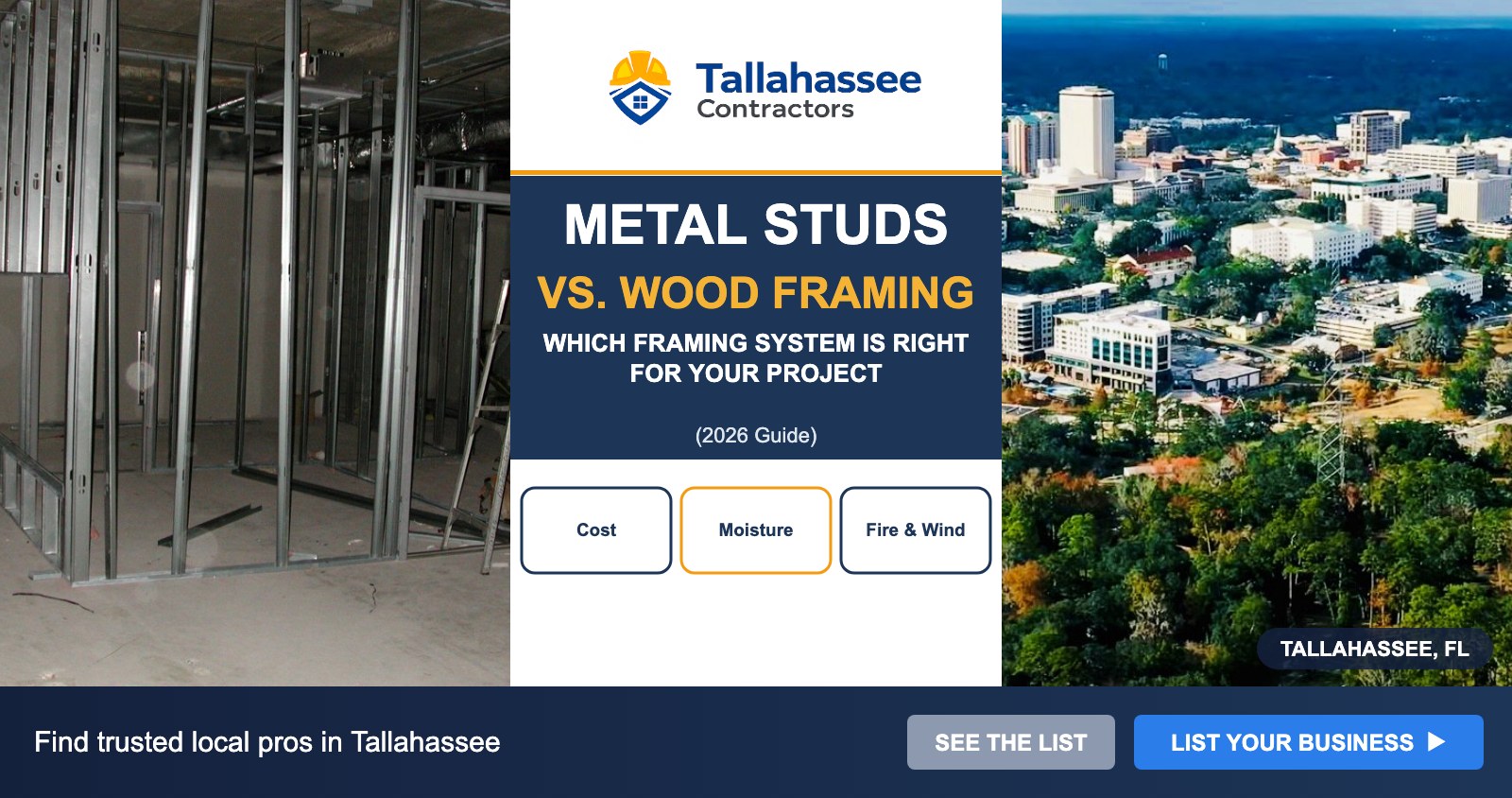
Framing is the skeleton of every building. In Tallahassee, you’ll see wood framing on most single-family homes and light-gauge steel (metal studs) in most commercial interiors, offices, medical buildings and mid-rise projects. Each material has strengths, and the right choice depends on the project, budget and building code requirements.

Wood Framing: The Residential Standard
Advantages
- Familiar and versatile. Most residential crews are trained in wood framing.
- Easy to attach to. Cabinets, trim, shelving and fixtures fasten easily.
- Good for load-bearing walls in typical homes.
- Simple on-site adjustments with common tools.
Drawbacks
- Moisture and rot. Wood can rot when wet — a real concern in North Florida.
- Termites. Wood framing needs termite protection and inspections.
- Movement. Lumber can warp, shrink or twist, causing drywall cracks or nail pops.
- Combustible. Wood burns, which limits its use in some commercial occupancies.
Metal Stud (Light-Gauge Steel) Framing
Advantages
- Won’t rot and termites won’t eat it.
- Straight and consistent, producing flat walls.
- Non-combustible, which helps meet fire-resistance requirements in commercial buildings.
- Lightweight and fast for interior partitions.
Drawbacks
- Requires specific skills and tools.
- Harder to hang heavy items without blocking or backing.
- Thermal bridging. Steel conducts heat, which matters for exterior walls and energy performance.
- Sharp edges and different fastening methods.
- Structural steel studs require engineering for load-bearing use.
Where Each Is Typically Used in Tallahassee
- Single-family homes: mostly wood framing.
- Commercial tenant build-outs: mostly metal studs for interior walls — see our build-out guide.
- Offices, clinics and retail: metal stud interior partitions are common.
- Mid-rise student housing and multifamily: a mix of systems depending on construction type and code.
- Bathrooms and wet areas in commercial buildings: metal studs with moisture-resistant board.
Cost Considerations
Material prices for lumber and steel change over time, so neither is always cheaper. Labor availability matters too: in residential settings, wood crews are more common; in commercial settings, metal framing crews are standard. The cheapest material isn’t always the cheapest wall once labor, blocking, insulation and finishing are included.
Hurricanes and Wind
Both systems can be designed to meet Florida’s wind requirements. What matters most is proper engineering, connections and installation — straps, anchors, fastening schedules and sheathing — not just the stud material.
Questions to Ask Your Contractor
- Which framing system does the code or design require for this project?
- How will you handle blocking for cabinets, TVs, grab bars and fixtures?
- How will insulation and energy requirements be met?
- What experience does your crew have with this system?
FAQ
Can metal studs be used in houses?
Yes, especially for interior partitions or where moisture and termites are concerns, though wood remains far more common in homes.
Are metal studs stronger than wood?
It depends on gauge, size and design. Structural steel framing can be very strong, but interior non-structural studs are lightweight and not meant to carry loads.
Find Framing Contractors
Compare metal framing contractors and wood framing contractors in Tallahassee.
Image credits — cover image adapted from: Light gage metal framing by P199, Public domain, via Wikimedia Commons; Tallahassee Skyline 2023 by Urbantallahassee, CC BY-SA 4.0, via Wikimedia Commons. Photos used under their respective licenses.


Leave a Reply